
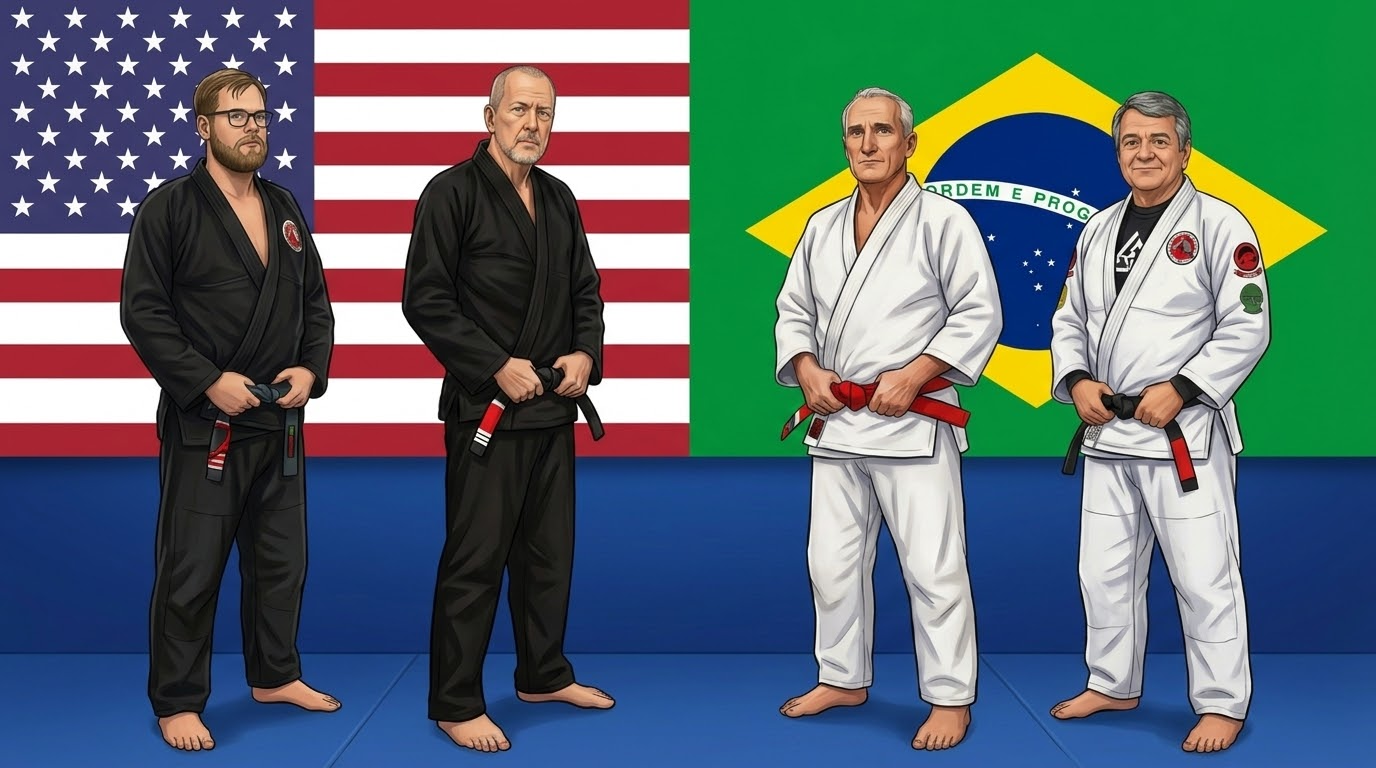
Luiz Palhares’ Comment on American Gracie Jiu-Jitsu Father–Son Black Belts: Context and Facts
When respected Gracie Jiu-Jitsu instructor Luiz Palhares commented that he had never heard of a father and son both holding Gracie black belts in the United States, it raised important questions within the Brazilian Jiu-Jitsu community. At first glance, the statement may appear inaccurate. However, a deeper look at history and lineage reveals that Luiz’s comment was both contextually accurate and historically significant.
Understanding Luiz Palhares’ Perspective
Luiz Palhares is a direct product of the Helio Gracie lineage, where rank is not simply awarded, but carefully documented and traced. His statement must be understood through that lens.
- Brazilian immigrants vs. American-born practitioners: Many early Gracie Jiu-Jitsu black belts teaching in the United States were Brazilian by birth. Even though they lived and taught in America, they were still viewed as Brazilian practitioners within the lineage community.
- First American-born black belts: Luiz was likely referring specifically to Americans who were born, trained, and promoted entirely in the United States under Gracie Jiu-Jitsu lineage—not Brazilians who later relocated.
- Strict lineage standards: Gracie Jiu-Jitsu maintains one of the most carefully preserved lineages in martial arts. Claims alone do not establish historical fact—documentation and instructor verification matter.
Father–Son Black Belts in BJJ vs. Gracie Jiu-Jitsu
It is important to separate general Brazilian Jiu-Jitsu from Gracie Jiu-Jitsu lineage.
There are multiple father–son black belt pairs in BJJ worldwide. There are also several examples within the Brazilian Gracie family itself. However, these cases typically fall into one of two categories:
- Brazilian families earning belts in Brazil or under Brazilian lineage
- Members of the Gracie family promoting their own sons
While historically important, these examples are different from American-born practitioners earning Gracie Jiu-Jitsu black belts under a U.S.-based Gracie lineage instructor.
The Speight Father–Son Milestone
This is where the historical distinction becomes clear.
James Speight (father) and Jay Speight (son) represent a rare and possibly first-of-its-kind milestone:
- Both are American-born practitioners
- Both earned authentic Gracie Jiu-Jitsu black belts
- Both were promoted in the United States
- Both trained under Luiz Palhares, whose lineage traces directly back to Helio Gracie
This places them outside the Brazilian immigrant context and outside the original Gracie family bloodline, making their achievement historically unique.
Why Luiz’s Statement Holds Up
When viewed through the proper historical and lineage-based framework, Luiz Palhares’ statement remains accurate. He was not denying the existence of father–son black belts globally, nor within the Gracie family itself. Rather, he was acknowledging that he had never encountered a documented case of an American-born father and son both earning Gracie Jiu-Jitsu black belts under a verified Gracie lineage in the United States.
Conclusion
Luiz Palhares’ comment highlights an important distinction in Brazilian Jiu-Jitsu history: the difference between Brazilian lineage moving to America and Americans earning Gracie Jiu-Jitsu black belts within the U.S. system itself.
While father–son black belts exist in BJJ and within the Gracie family worldwide, James and Jay Speight stand as a historically significant example of the first known American-born father and son to earn authentic Gracie Jiu-Jitsu black belts.
Understanding this context preserves the integrity of Gracie Jiu-Jitsu history and honors the pioneers who helped establish the art in the United States.