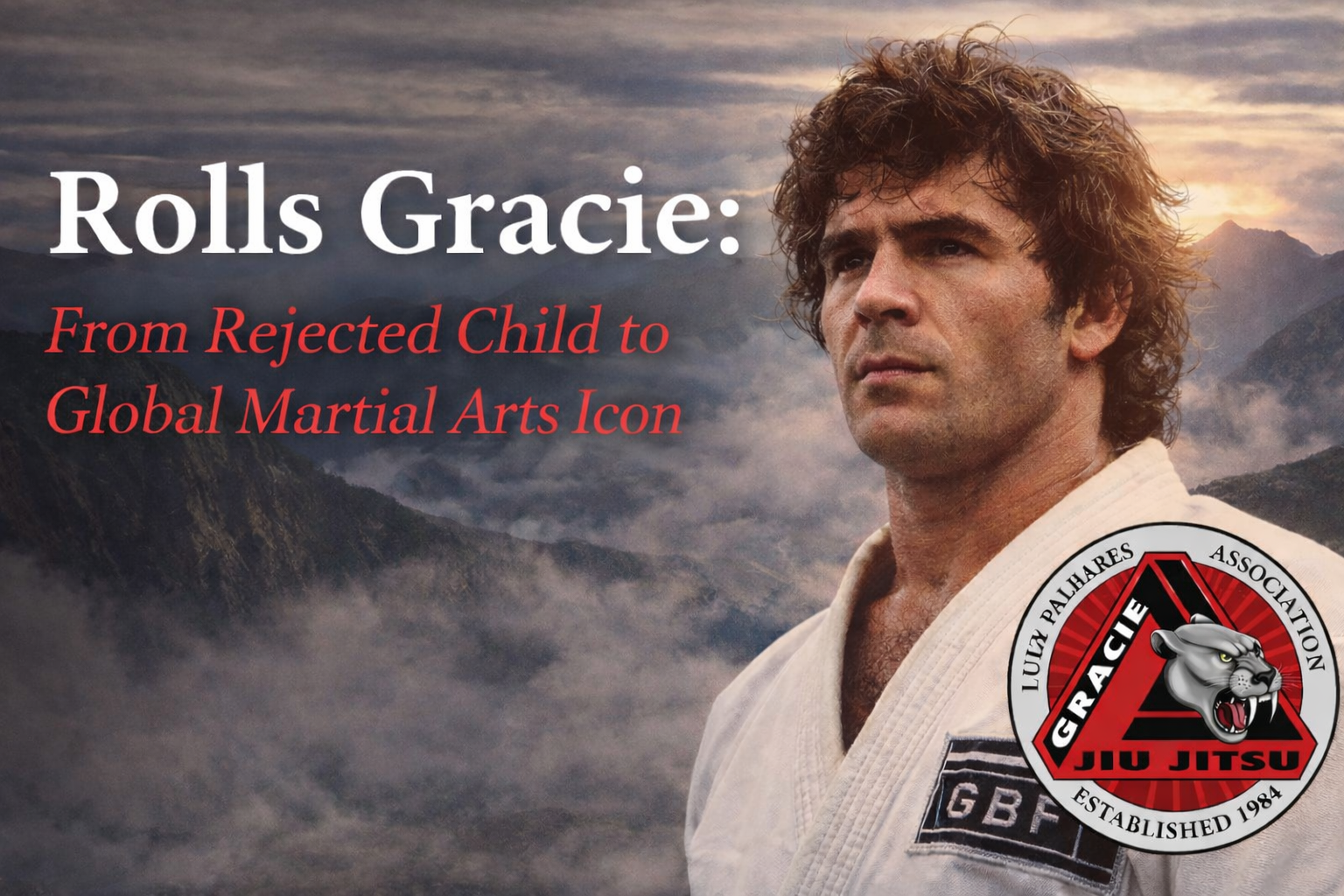
Rolls Gracie was born on March 28, 1951, in Rio de Janeiro, Brazil, into a complicated family situation that would set the stage for a life of resilience, leadership, and innovation. He was the biological son of Carlos Gracie, one of the founders of Brazilian jiu-jitsu, and Claudia Zandomenico, a young woman who worked for an airline and later traveled internationally.
Because of family tensions — Carlos’ wife at the time refused to raise Rolls — he was sent away as an infant. At just four months old, Rolls was taken in by his uncle Hélio Gracie, who, along with his wife, fed him, clothed him, and raised him as one of their own sons. Rolls grew up alongside Hélio’s biological children — Rorion, Relson, and Rickson Gracie — forming bonds that were as deep as they were enduring.
Hélio later described Rolls as “very hyper, but with a great heart.” That combination of fearless energy and compassion became the hallmark of his life — on the mats, in the family, and in the wider world of martial arts.
A Brother, Leader, and Mentor
From a young age, Rolls was more than a cousin or student — he was a natural older brother to the boys who trained with him. He guided, pushed, and inspired them. He set the standard in technique, discipline, and courage, and in doing so, became a central figure in the Gracie household.
Rickson Gracie often referred to Rolls as a benchmark of excellence, someone who shaped his own relentless approach to training and life. Meanwhile, Royler Gracie summarized Rolls’ impact on history with a single line:
“There is an era before, and another one after Rolls.”
Even beyond the family, Rolls’ students and peers recognized his influence. Romero “Jacaré” Cavalcanti, founder of Alliance Jiu-Jitsu, recalled:
“He was by far the best fighter of his time — intense, cold, fast, technical, unbelievable, and never refused a challenge. With all of that, he was still a true gentleman.”
Maurício Gomes, another of Rolls’ earliest black belts, described the shock of losing him:
“We were lost; we were completely lost … like losing a family member, like losing a limb.”
For those he trained and led, Rolls was more than a teacher — he was a guide and father figure, someone whose presence shaped lives on and off the mats.
The Advantage of an International Childhood
One unique aspect of Rolls’ upbringing was his connection to his mother, Claudia, who worked for an airline. This gave Rolls early exposure to international travel, allowing him to visit countries like the United States and gain experiences beyond Brazil — opportunities that most Gracie family members did not have at the time.
This international exposure helped shape Rolls into:
- A global thinker — seeing different cultures and sports broadened his perspective on training and competition.
- An innovator — he was more willing than many to integrate techniques from judo, sambo, and wrestling into his Brazilian jiu-jitsu.
- A networked leader — his travel helped connect him to practitioners worldwide, laying the groundwork for his lasting influence.
It’s easy to see why Rolls’ approach to jiu-jitsu was so forward-thinking: he was literally raised between two worlds — the structured, disciplined environment of Helio’s household in Brazil, and the wider world of international travel and exposure to different athletic traditions.
Innovation, Competition, and Influence
Rolls became known as a pioneer in jiu-jitsu. While many practitioners stayed strictly within the traditional Gracie style, Rolls experimented, integrated, and innovated — blending wrestling takedowns, judo throws, and sambo sweeps into his teaching.
His classes were intense and dynamic, always pushing students to think creatively and adapt. Romero Cavalcanti noted that Rolls’ willingness to explore new ideas fundamentally shaped the way Brazilian jiu-jitsu evolved, helping to lay the foundation for modern competitive jiu-jitsu.
Even in competition, Rolls’ combination of technique, athleticism, and creativity set him apart. He was fearless, disciplined, and technically brilliant, and he trained his younger “brothers of the heart” to embody the same principles.
A Tragic End at the Height of His Life
Rolls’ life, however, was cut tragically short. On June 6, 1982, at just 31 years old, he died in a hang-gliding accident in Visconde de Mauá, Brazil — a sport that reflected his adventurous, fearless personality.
The loss was profoundly felt: his younger brothers of the heart, his students, and peers all struggled with the absence of a leader, guide, and brother figure. Maurício Gomes remembered:
“We were completely lost … like losing a limb.”
Jacaré Cavalcanti echoed that sentiment:
“He set a good example for me and influenced a whole generation. Losing him felt like losing the center of our world.”
Even the Gracie family, who had always been close-knit, felt the weight of his absence. Rolls had been the glue between the older and younger generations — a bridge that suddenly vanished.
A Legacy That Lives Forever
Although Rolls lived only 31 years, his influence continues to shape Brazilian jiu-jitsu worldwide. His original black belts, like Maurício Gomes and Romero Cavalcanti, went on to teach thousands, spread his innovations, and honor his vision.
His contributions weren’t only technical — they were philosophical: teaching innovation, courage, respect, and leadership alongside jiu-jitsu.
Today, anyone who trains in modern BJJ, integrates cross-training, or values creativity in grappling is standing on the shoulders of Rolls Gracie. His story — from a rejected child to an internationally exposed, innovative, and beloved leader — is a testament to resilience, guidance, and the enduring power of family and mentorship.
As his cousin Royler said:
“There is an era before, and another one after Rolls.”
And as Rickson reflects:
“He set the standard for what it means to be a brother, a competitor, and a man of principle.”
Rolls’ life may have been short, but his legacy is eternal, touching every mat where Brazilian jiu-jitsu is practiced.