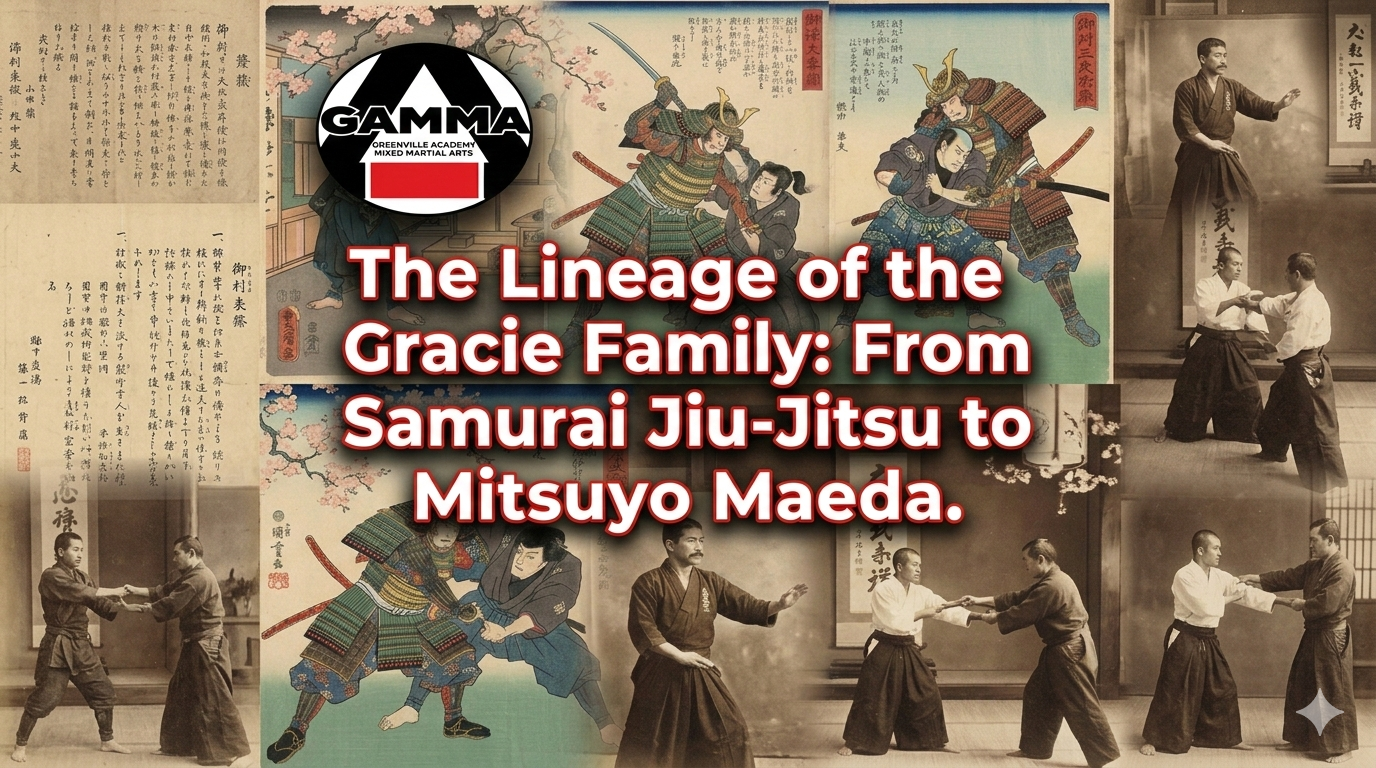
The story of the Gracie family begins long before Brazilian Jiu-Jitsu became a global phenomenon. It begins in Japan, with centuries of martial tradition, and follows the journey of one man, Mitsuyo Maeda, whose teaching would eventually shape the Gracie family’s legacy.
1. Classical Japanese Jiu-Jitsu: The Foundation
The roots of the Gracie family’s martial knowledge lie in classical Japanese jiu-jitsu (jujutsu), a combat system developed over centuries for the samurai. Jiu-jitsu was a versatile martial art, designed to subdue armed or armored opponents without weapons. Its techniques included throws, joint locks, strikes, and grappling methods.
Some of the most influential jujutsu schools included:
- Takenouchi-ryu (c. 1532) – One of the oldest martial systems in Japan, emphasizing throws, locks, and battlefield techniques.
- Tenjin Shinyo-ryu (1830s) – Focused on strikes, joint manipulation, chokes, and groundwork.
- Kito-ryu (17th–19th century) – Renowned for its mastery of balance, timing, and throwing techniques.
These schools cultivated a deep understanding of leverage, balance, and control—concepts that would later influence the next evolution of martial arts in Japan.
2. Jigoro Kano and the Birth of Judo
At the end of the 19th century, Jigoro Kano (1860–1938) synthesized elements from multiple jujutsu schools to create Kodokan Judo. Kano’s innovations were revolutionary:
- He emphasized leverage over strength, allowing smaller practitioners to overcome larger opponents.
- He introduced randori (free practice), a safe way to train full-contact techniques.
- He structured Judo as both a physical and moral discipline, combining practical combat skills with educational principles.
Kano’s system transformed traditional jiu-jitsu from a battlefield art into a modern martial discipline that could be practiced safely and effectively.
3. Mitsuyo Maeda: Bringing Judo to the World
One of Kano’s most accomplished students was Mitsuyo Maeda (1878–1941), also known as “Count Koma.” Maeda was a skilled judoka and prizefighter who traveled extensively to demonstrate and test his skills in real combat situations.
Maeda’s journey took him across the globe, eventually bringing him to Brazil in 1914. His influence on the Gracie family was profound:
- Maeda taught Carlos Gracie and his brothers directly.
- He emphasized practical fighting techniques, including throws, joint manipulation, and groundwork.
- Maeda’s teaching laid the foundation for the Gracie family’s lifelong dedication to mastering martial arts.
Through Maeda, the knowledge of centuries of Japanese martial tradition was transferred to a new generation in Brazil, bridging two worlds and setting the stage for future developments.
Conclusion
The lineage of the Gracie family traces back centuries, from samurai jiu-jitsu schools in Japan to the Kodokan Judo of Jigoro Kano, and finally to Mitsuyo Maeda, who brought these techniques to Brazil. This lineage highlights a continuous thread of martial innovation, adaptation, and mastery—long before the art became a global phenomenon under the Gracie name.