
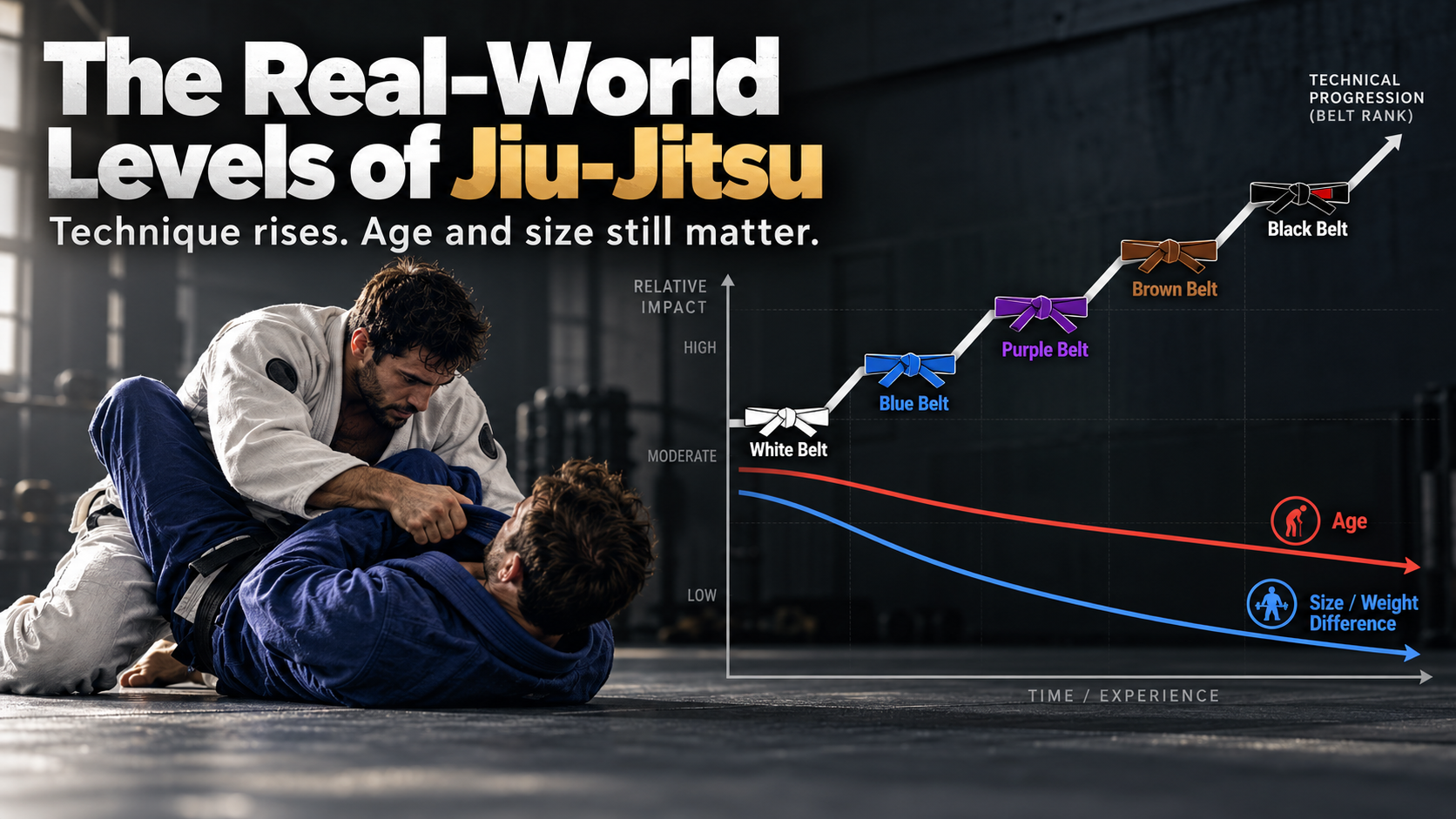
Rank Matters — But So Do Age, Size, and Respect
Brazilian Jiu-Jitsu and Gracie Jiu-Jitsu have a ranking system most people understand. You begin as a white belt. With years of training, knowledge, mat time, and experience, you may progress through blue, purple, brown, and eventually black belt.
Those belts mean something. They represent knowledge, experience, technical understanding, and thousands of hours spent learning the art.
But there is another truth that experienced martial artists understand:
We are not superhuman.
A black belt does not magically stop aging. A purple belt does not suddenly become immune to a 50-pound weight difference. Technique is incredibly important, but age, strength, athleticism, injuries, conditioning, and body size still exist.
That is why I sometimes explain real-world grappling with an unofficial system of “adjusted levels.”
It isn’t an official BJJ ranking system. Nobody is actually losing a belt because they had a birthday. It is simply a practical way to understand why two people with different ranks may be much more evenly matched than their belt colors suggest.
Age Changes the Equation
Imagine a highly experienced practitioner who has been training for decades.
At 25 or 30 years old, that person’s speed, recovery, explosiveness, grip strength, flexibility, and endurance may be near their physical peak.
Now put that same practitioner on the mat at 50, 60, or 70.
The knowledge may actually be greater. The timing may be better. The technique may be more refined.
But the body has changed.
As a rough training-room illustration, I sometimes think of every 10 years of age difference as potentially representing something close to a belt-level physical adjustment.
That doesn’t mean a 60-year-old black belt suddenly has the knowledge of a blue belt. Absolutely not.
It means that when you are evaluating what actually happens during live rolling, you have to recognize the physical difference between a 25-year-old athlete and someone several decades older.
There are exceptional older athletes, of course. There are also young athletes who aren’t particularly strong or athletic. This isn’t mathematics.
It is perspective.
Size Changes the Equation Too
Jiu-Jitsu became famous partly because technique allows a smaller person to defeat a larger opponent.
That is absolutely true.
But somewhere along the way, some people began interpreting that to mean that size doesn’t matter.
Size matters.
If it didn’t, we wouldn’t have weight divisions.
A 150-pound grappler rolling with a 190-pound grappler is dealing with 40 additional pounds of pressure, strength, base, momentum, and potential force.
Again, as a simple teaching concept, you might think of every 10 or 20 pounds of meaningful size difference as another adjustment in the matchup.
It isn’t exact. But it helps explain reality.
Suppose you have a younger 200-pound blue belt rolling with a 160-pound brown belt in his 50s.
Someone watching only the belts might say:
“A brown belt should destroy a blue belt.”
But that isn’t necessarily how the real world works.
The blue belt may be 25 years younger, 40 pounds heavier, stronger, faster, and competing regularly.
When you account for those factors, the matchup becomes much closer than the belt colors suggest.
Could that blue belt catch the brown belt?
Of course.
That doesn’t suddenly mean the blue belt knows more Jiu-Jitsu.
It means two human beings were grappling.
A Tap Doesn’t Transfer Rank
This may be one of the most important lessons in a martial arts academy.
If a blue belt catches a brown belt, the blue belt doesn’t become a brown belt.
And the brown belt doesn’t become a blue belt.
A submission during training is simply one moment during one round.
Maybe the higher belt was tired.
Maybe he was working from a bad position.
Maybe he was allowing the younger student to attack.
Maybe he was experimenting with something.
Maybe the lower belt simply executed a beautiful technique.
Or maybe the younger student was just better during that particular exchange.
That’s okay.
Training is supposed to be a place where people can make mistakes.
If nobody ever catches you, you probably aren’t putting yourself into difficult enough situations.
The Training Room Is Not a Street Fight
Another mistake happens when people start treating gym rounds like actual fights.
We aren’t trying to hurt each other. We aren’t defending our families. There isn’t money on the line. Nobody is trying to survive.
We’re training.
Good teammates allow positions to develop. Experienced practitioners sometimes give openings so another student can work. People experiment with techniques they aren’t good at yet.
A 55-year-old black belt isn’t necessarily trying to physically dominate a 22-year-old blue belt every second of every round.
He may be teaching him.
He may be developing him.
And sometimes he may simply be trying to get through another day of training without destroying a knee, shoulder, or neck that has already survived decades on the mat.
What Happens in the Gym Should Stay in the Gym
Social media has changed martial arts culture.
Years ago, somebody might have caught an instructor or senior student during training and thought:
“Wow. I finally got him today.”
Maybe the two of them would laugh about it.
Today somebody can walk out of the academy, grab a phone, and announce to the world:
“I tapped a black belt.”
That misses the entire purpose of training.
There is a difference between being proud of your improvement and disrespecting the people who helped create that improvement.
The senior practitioner you caught may have spent years teaching you exactly how to perform the technique you used against him.
Respect that.
You don’t have to pretend something didn’t happen. But you should understand the environment in which it happened.
Gym victories belong in the gym.
Respect the People Who Came Before You
Eventually every young grappler becomes an older grappler.
The 22-year-old competitor laughing about catching a 55-year-old black belt may someday be the 55-year-old black belt rolling with a strong 22-year-old.
Hopefully by then he will understand.
Martial arts aren’t supposed to teach us arrogance.
They’re supposed to teach us perspective.
Belts matter. Technique matters. Experience matters.
But so do age, weight, strength, injuries, conditioning, and athletic ability.
When two people step onto the mat, all of those things step onto the mat with them.
So celebrate your progress. Be proud when you execute a technique correctly. Train hard. Test yourself.
But remember something even more important:
A good training partner helps you become better. A good martial artist remembers who helped him get there.
Respect the belt.
Respect the years behind it.
Respect your training partners.
And understand that sometimes the greatest accomplishment of an older martial artist isn’t proving that he can still defeat every young athlete in the room.
It’s that after 20, 30, or 40 years…
He’s still on the mat.