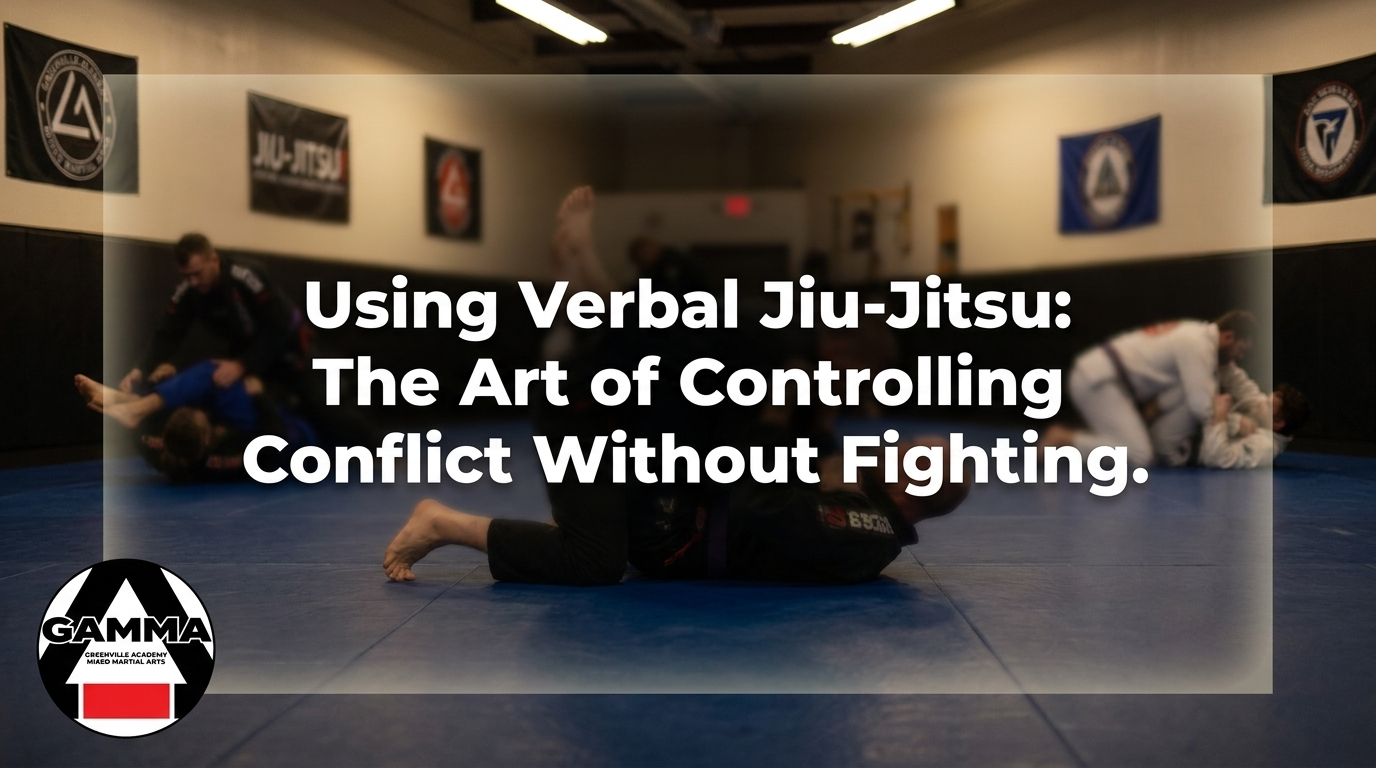
Instead of grappling with bodies, you are managing emotions, ego, and escalation.
For someone with martial arts experience, especially in Brazilian Jiu-Jitsu, this concept is not abstract—it is familiar. The goal is not to “win the exchange,” but to control the situation and leave safely.
The Core Principle: Don’t Meet Force With Force
In physical Jiu-Jitsu, resisting raw strength often leads to exhaustion and vulnerability. The same applies in conversation.
When someone becomes verbally aggressive, matching their intensity usually escalates the situation.
You do not absorb the energy—you redirect it.
Instead of arguing or defending every insult, you stay calm and change the direction of the interaction.
Principle 1: Emotional Control is Your Base Position
In grappling, bad posture leads to bad outcomes. In conflict, emotional reaction is the same.
- Getting angry breaks control
- Raising your voice escalates risk
- Becoming defensive reduces awareness
Verbal Jiu-Jitsu begins with staying emotionally neutral under pressure. It is not passivity—it is stability.
“I am not here to match emotion. I am here to manage space.”
Principle 2: Do Not Accept the Invitation to Fight Emotionally
Many confrontations are invitations to ego conflict. Statements like “You’re disrespecting me” or “Say it again” are often traps designed to provoke escalation.
In Verbal Jiu-Jitsu, you recognize the invitation—but do not take it.
Example:
- Aggressive: “You’re disrespecting me!”
- Reactive: “No I’m not, you’re crazy!”
- Controlled: “I hear that you’re upset. I’m not trying to argue with you.”
Principle 3: Acknowledge Without Surrendering Control
Strategic acknowledgment reduces tension without admitting fault.
- “I understand why you feel that way.”
- “I hear you.”
- “I can see how it might look like that.”
These responses reduce emotional resistance while keeping control of the situation.
Principle 4: Distance Is Still the Goal
In Jiu-Jitsu, distance creates safety. In verbal conflict, emotional distance does the same thing.
The goal is always:
- Reduce emotional engagement
- Create space
- Increase time for de-escalation
Principle 5: Don’t Feed the Ego
Most conflicts are ego-driven rather than truth-driven.
When you refuse to escalate, you remove the fuel from the interaction.
Sometimes that means:
- Light acknowledgment of minor truths
- Humor when appropriate
- Or disengaging entirely
Principle 6: Disengagement Is a Win Condition
A successful outcome is not winning the argument—it is leaving without escalation.
“I’m going to go ahead and step away from this.”
Walking away is not weakness—it is control.
Principle 7: Awareness Prevents Most Escalation
Early awareness prevents most conflict from becoming physical or legal.
- Rapid tone changes
- Invasion of personal space
- Repeated accusations
- Fixation on one emotional trigger
Final Thought: Control Over Chaos
Verbal Jiu-Jitsu is not about passivity—it is about control under pressure. It reflects a core martial principle:
The highest level of skill is not domination—it is composure under pressure.
Real strength is not reacting emotionally. Real strength is staying calm while others lose control.