
We all know how you feel. You found something you love. Maybe it’s Brazilian Jiu-Jitsu, MMA, boxing, or fitness training. You’re excited. You’re improving. You finally found something that pushes you physically and mentally in a positive way.
Then the thought comes:
“Maybe I should just put some mats down at home and invite a few people over to train.”
At first, it sounds harmless. Maybe even smart. But before you start turning the garage into a “mini academy,” take a step back and think long term. What starts as “just a few friends training” can slowly create problems for the academy, the students, and even your own progress.
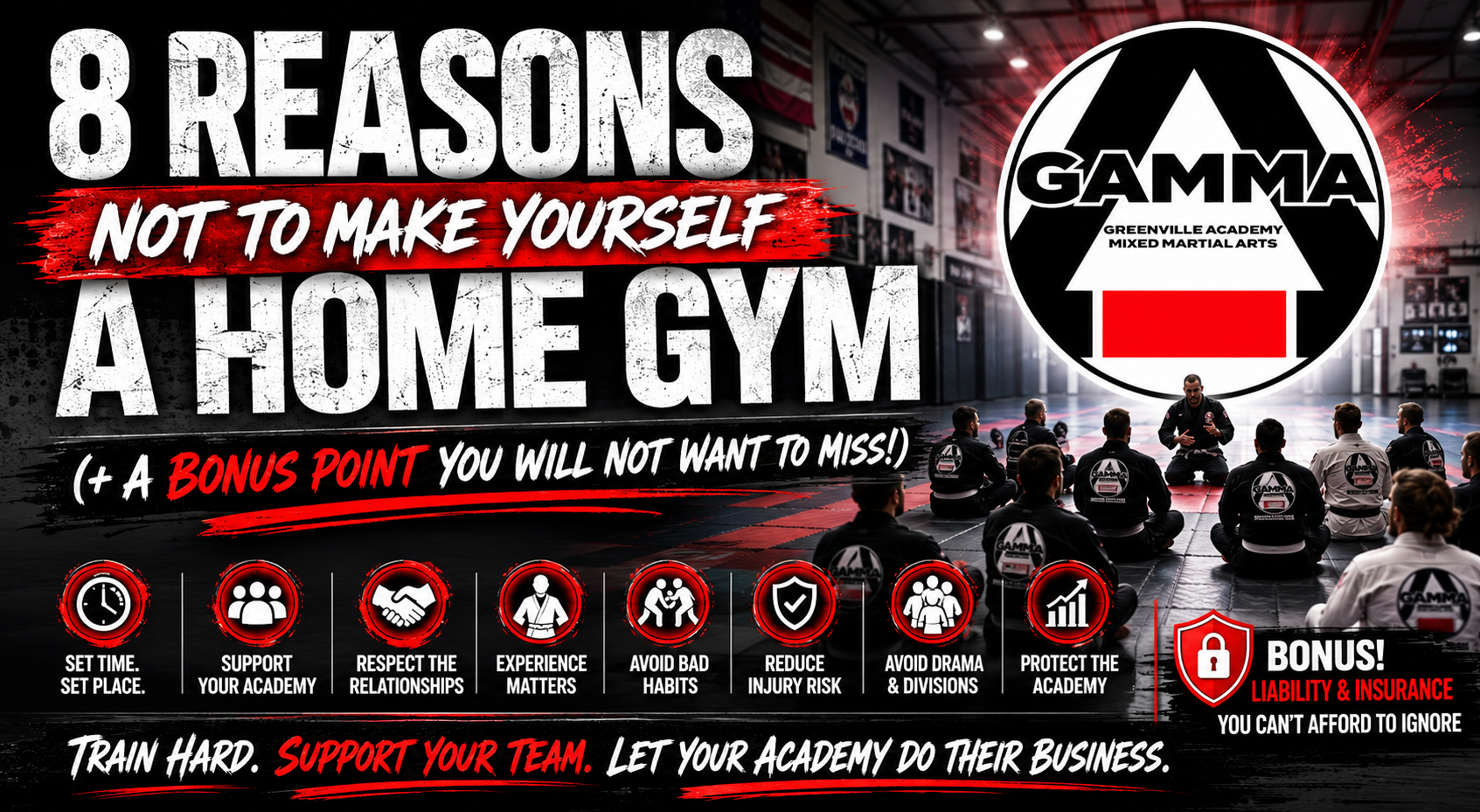
Here are 8 reasons why resisting the home gym temptation is usually the better decision — and a bonus point you will not want to miss.
1. Training Should Be at a Set Time and Set Place
One of the biggest reasons martial arts schools succeed is structure.
Class starts at a certain time. Everyone shows up together. Everyone trains together. The environment creates accountability and consistency.
When training moves into a garage or basement, things become random:
- “Maybe tonight.”
- “Maybe next week.”
- “Who’s coming?”
- “We’ll start when everybody gets here.”
That structure disappears quickly.
A real academy creates a culture where beginners, advanced students, competitors, hobbyists, kids, and adults all improve together. A home setup usually becomes a private invite-only session that excludes the rest of the team.
Martial arts grow best when everyone shares the same mat together.
2. It Diverts Students Away From the Academy
This is one people rarely think about in the beginning.
When students start organizing garage training nights, some people eventually stop showing up to the academy as much.
Why?
- “I’ll just train over there tonight.”
- “It’s cheaper.”
- “It’s more convenient.”
- “I don’t feel like driving.”
The academy slowly loses attendance, energy, and momentum.
A strong school depends on students consistently showing up. Every student contributes to the atmosphere, learning environment, and team chemistry.
Even if the intentions are good, splitting training between unofficial groups weakens the academy over time.
3. These Are the Academy’s Students — You Met Them There
This one matters more than people realize.
The relationships were built through the academy. The instructor created the environment where everybody met, trained, and became teammates.
Without the academy, most of those friendships would never have existed.
There’s an unspoken respect in martial arts:
You leave academy business at the academy.
That doesn’t mean people can’t be friends outside of class. Of course they can. But creating separate training groups with academy students can blur lines quickly and create unnecessary division.
A healthy team stays centered around the school that brought everyone together.
4. Coaching Without Experience Can Create Bad Habits
Watching videos online does not make someone an instructor.
One of the biggest dangers of home training groups is that people start “teaching” before they truly understand what they’re doing.
Small mistakes become permanent habits:
- sloppy technique
- poor fundamentals
- unsafe training
- incorrect details
- unrealistic reactions
In martial arts, repetition builds instinct. If you repeat bad technique long enough, it becomes difficult to fix later.
A qualified academy instructor sees mistakes students don’t even realize they’re making.
5. Home Training Often Turns Into Goofing Around
At the academy, people train with purpose.
At home?
It often turns into:
- talking more than training
- people arriving late
- random music and distractions
- rough sparring
- horseplay
- inconsistent intensity
The atmosphere changes completely.
What felt like “extra training” slowly becomes social hangout time with occasional grappling mixed in.
There’s nothing wrong with friends hanging out. But don’t confuse hanging out with serious development.
6. Injuries Become More Likely
Academies are designed for training:
- proper mats
- spacing
- supervision
- safety rules
- controlled environments
Most garages and basements are not.
Someone gets slammed near concrete.
Someone crashes into a wall.
Someone trains too hard trying to “win” in front of friends.
Without experienced supervision, injuries become far more common.
And if somebody gets seriously hurt in your home gym setup, the situation can become complicated very fast.
7. It Can Create Drama and Divisions
This happens more often than people admit.
Small private training groups sometimes evolve into:
- cliques
- gossip circles
- “us vs them” mentalities
- disagreements about instruction
- hurt feelings over invitations
- students picking sides
Most academies work hard to create a team environment. Separate garage groups can unintentionally fracture that culture.
The irony is that most people start these setups trying to build friendships — but over time, they sometimes damage the very relationships they were trying to strengthen.
8. The Academy Needs Your Support
Good academies are not easy to run.
People often see the classes, mats, and instruction — but they don’t see:
- rent
- utilities
- insurance
- equipment costs
- cleaning
- scheduling
- years of experience
- sacrifices the instructor made to build the school
If students slowly shift training away from the academy, the school suffers.
And if the academy disappears, everybody loses:
- the structure
- the instructors
- the community
- the opportunities to grow
Supporting your academy means more than just paying dues. It means helping preserve the environment that helped you improve in the first place.
Bonus Reason: Liability and Insurance Are a Bigger Problem Than Most People Realize
This is the part almost nobody thinks about until something goes wrong.
Most individuals cannot personally take on the liability that comes with running training sessions out of a garage, basement, or spare room.
Your instructor is insured.
Your academy is insured.
But more importantly, they are insured under specialized policies specifically designed for martial arts and combat sports activities.
Your average homeowner’s or renter’s insurance policy is NOT designed for this type of activity.
In many cases:
- injuries from martial arts activities are excluded
- business-related activities are excluded
- organized training can void coverage entirely
That means if someone gets seriously hurt in your garage, there may be no liability coverage at all.
And here’s the part many people do not realize:
If your homeowners insurance company discovers you are operating martial arts training sessions out of your garage, they can potentially cancel your policy altogether.
Even our own academy experienced something similar.
“Your policy doesn’t cover these activities. You didn’t tell us what you were doing here!”
He calmed down once he was shown the specialized policy specifically covering martial arts academy operations.
That is the difference between a properly insured academy and an informal garage setup.
But the problem gets even bigger.
If you are training people at home while also connected to an academy, you may unintentionally put the academy itself at risk.
When somebody gets hurt, attorneys look for “deep pockets” — meaning businesses or organizations with larger insurance policies and assets.
If an injury happens in a garage:
- the homeowner’s policy may deny the claim
- the injured person may look elsewhere for compensation
- attorneys may trace the activity back to the academy
- now the academy is involved in a situation they never approved or controlled
Suddenly, what started as “a few friends training” becomes a legal and insurance nightmare.
That academy is not just your hobby.
It is someone’s business.
Someone’s livelihood.
Someone’s years of sacrifice, investment, and risk.
Train hard.
Support your teammates.
Love the art.
But let the academy handle the academy business.